Description
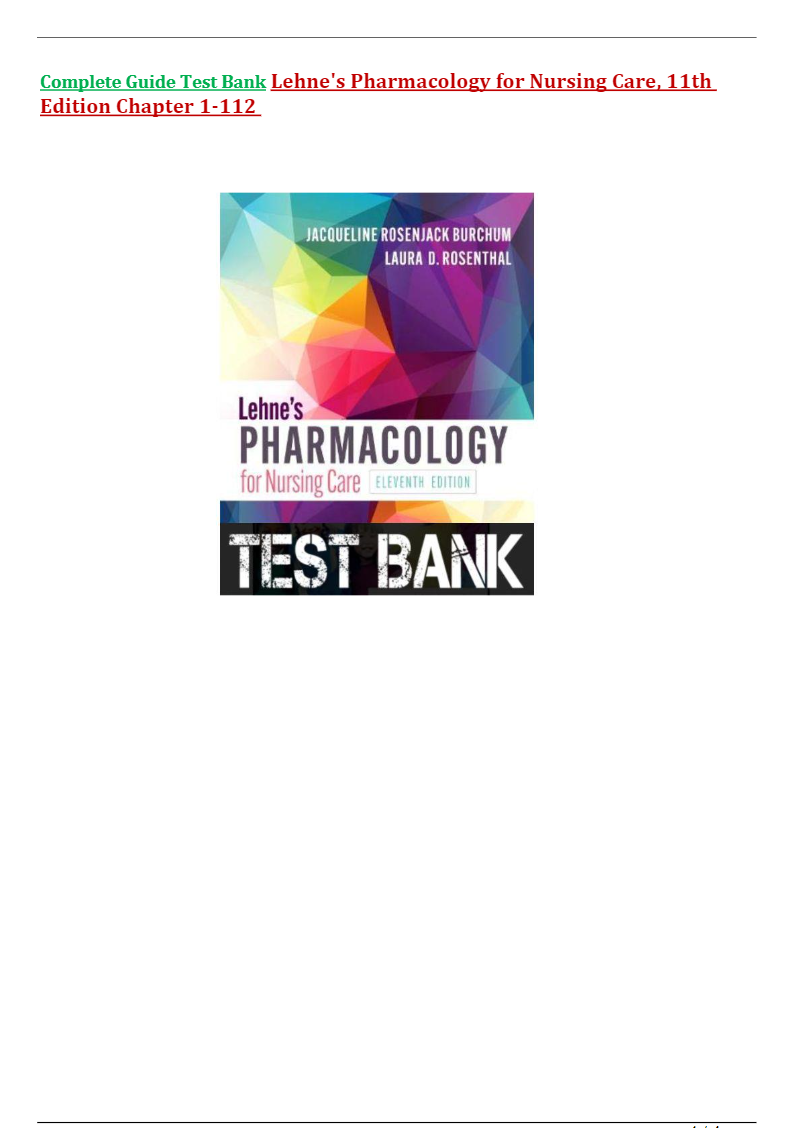
Lehne’s Pharmacology for Nursing Care 11th Edition Chapter 1-112 Test Bank
Chapter 01: Orientation to Pharmacology
Burchum: Lehne’s Pharmacology for Nursing Care, 11th Edition
MULTIPLE CHOICE
1. The nurse is teaching a patient how a medication works to treat an illness. To do this, the nurse
will rely on knowledge of which topic?
a. Clinical pharmacology
b. Drug efficacy
c. Pharmacokinetics
d. Pharmacotherapeutics
ANS: D
Pharmacotherapeutics is the study of the use of drugs to diagnose, treat, and prevent conditions.
Clinical pharmacology is concerned with all aspects of drug-human interactions. Drug efficacy
measures the extent to which a given drug causes an intended effect. Pharmacokinetics is the
study of the impact of the body on a drug.
PTS: 1
2. What is a desired outcome when a drug is described as easy to administer?
a. It can be stored indefinitely without need for refrigeration.
b. It does not interact significantly with other medications.
c. It enhances patient adherence to the drug regimen.
d. It is usually relatively inexpensive to produce.
ANS: C
A major benefit of drugs that are easy to administer is that patients taking them are more likely to
comply with the drug regimen. Drugs that are easy to give may have the other attributes listed,
but those properties are independent of ease of administration.
PTS: 1
3. A patient tells the nurse that an analgesic he will begin taking may cause drowsiness and will
decrease pain up to 4 hours at a time. Based on this understanding of the drug’s effects by the
patient, the nurse will anticipate which outcome?
a. Decreased chance of having a placebo effect
b. Decreased motivation to take the drug
c. Improved compliance with the drug regimen
d. Increased likelihood of drug overdose
ANS: C
A drug is effective if it produces the intended effects, even if it also produces side effects.
Patients who understand both the risks and benefits of taking a medication are more likely to
comply with the drug regimen.
PTS: 1


Reviews
There are no reviews yet.